Evaluation Plan for Art Theater and Participation of Members and Audience
Audience Participation in Art and Blueprint
by Clara LaFrance | January 23, 2012
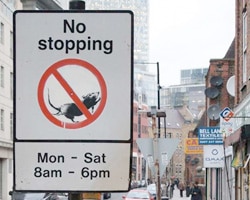
Banksy is a British graffiti artist and painter (the proper noun "Banksy' is a pseudonym; rumors abound as to who the real Banksy is though none are confirmed). He is best known for his satirical, often political stenciled designs in the U.Grand. The best-known pieces are graffiti and therefore considered vandalism by British regime. They're often scrubbed out equally quickly as they're put upwards in an ongoing attempt to keep public areas free of graffiti, giving the pieces a feel of the imperceptible; information technology won't be here long.
I'grand not going to argue virtually the validity, legality, or legitimacy of his work. What I'm going to comment on is the inclusion of the audience as an integral office of his work.
Nicholas Barber, a motion-picture show critic, writes about his own "Banksy Experience" hither. The description of the piece focuses on his personal experience of stumbling across it, considering its pregnant, its origin and its ephemeral nature. That'due south more to consider on a morning commute than a large latte.
Barber comments on the surprise and delight in "finding a Banksy," and this positive emotion is carried through and applied to the entire slice. The charmed surprise at the unlikely discovery, the question of authenticity, the mystery of the psuedonym combined with the temporary nature (as British authority accept come up downward on graffiti, which this, technically, is) makes the work quite alluring.
Why?
The viewer is expressly and specifically involved
Banksy'south pieces often require the viewer to mentally fill in the gap. The viewer is an integral part of the piece; the activeness of stumbling upon the painting unexpectedly in the first place is the very first footstep in a Banksy piece. His pieces are scattered around the United kingdom, on street signs, on abandoned buildings, on sea walls. Finding i takes the viewer off-guard; no one expects art on the way to piece of work in the morning.
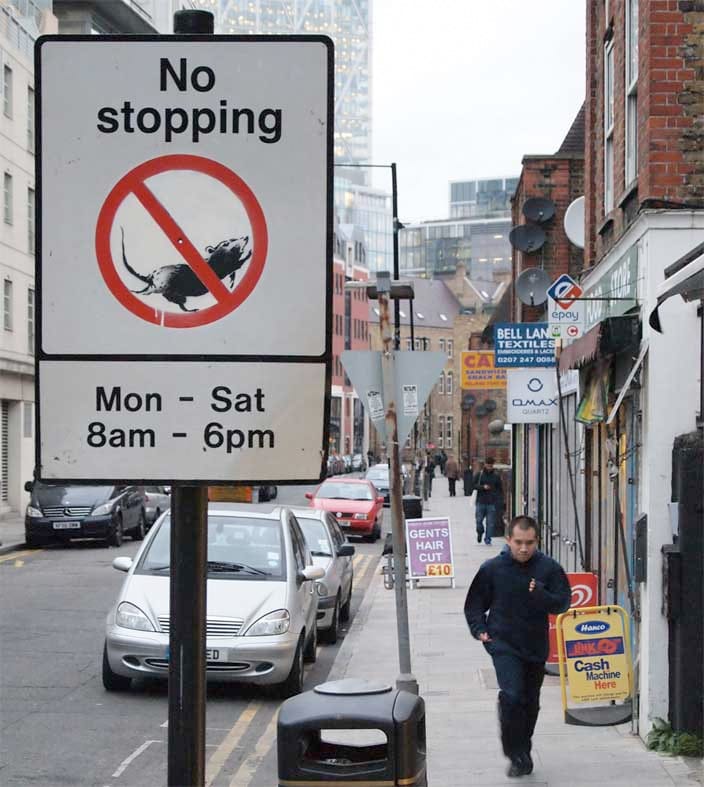
A rat is stenciled in a universal No sign nether the words No Stopping. The sign turns from a common traffic sign to a commentary on the 9-v workers' rat race; the No symbol is now a rat exercise wheel.
Simple.
Or not.
Oftentimes, the slice relies on the commonality of the audience, of the collective consciousness.
What can nosotros take from Banksy's art as artists ourselves?
Certainly I practise not think we should all start running around painting on all the walls in our hometowns under the cover of nighttime. But I exercise remember that we could all stand up to consider the part of the audience in our piece of work and the role that the audition tin play. The viewer does not have to exist passive. In fact, the viewer can be a very active function of fine art. How can nosotros, as artists, appoint our audience to create an feel that the audience will recall and retain? How can nosotros, as designers, create work that leaves a strong and articulate message?
Hairdresser's description focuses on his personal experience, starting with the moment he sees the piece unexpectedly. The moment of unexpectedness is described as "lucking into a new artistic experience." Who wouldn't want their art described that way? By inviting the audience to close the visual gaps, nosotros're including the audition in our process.
This piece uses white paper wrapped around trees to follow the horizon and blend in with to the greater properties of mountains or horizon line. What would it exist similar to come across this piece equally a hiker?

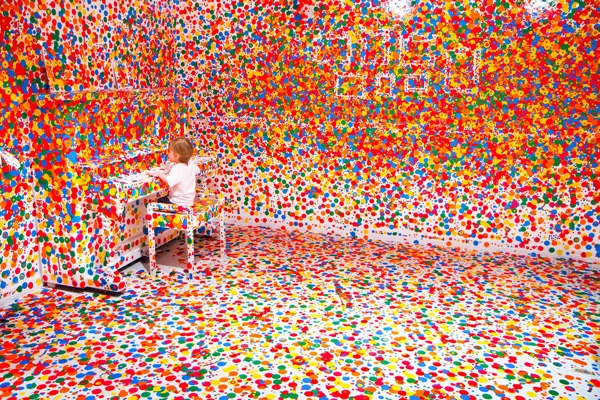
Installation art invites the audience to literally take part in a slice, the audience IS the process. In this case, the process is the art; the series of photos during the procedure is fine art, and the terminal 'production' is art, as well.
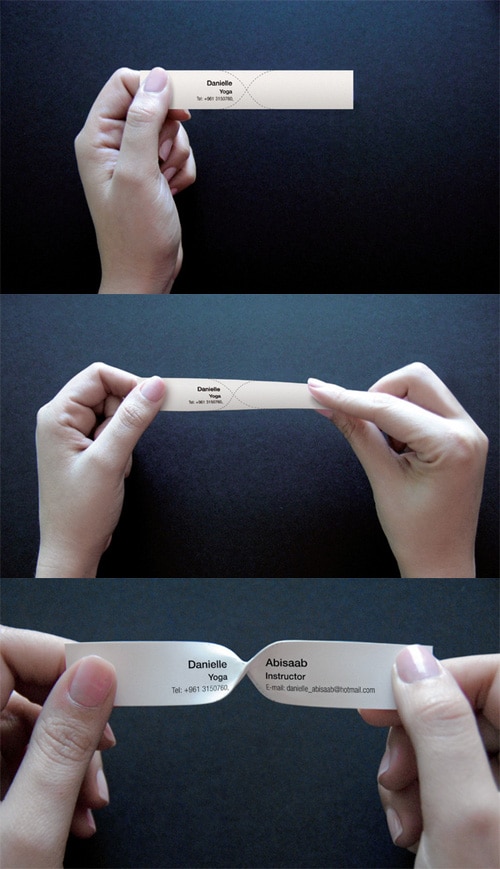
This Yoga instructor created a flexible business carte that requires the reader to twist it to read the contact information.
The Food writers' guild logo is reminiscent of the optical illusion of the vase and two faces in the negative infinite. Non only does the viewer see a pen and so a spoon, but makes the next bound of logic to connecting the symbols to the activities they each represent.

Each of these are clever or charming, and each one leaves a distinct impression on the audience, because each 1 requires input from the viewer. By continually respecting the intelligence of your audience and leaving a modest mental chore to be completed, you lot have connected with your audience. Past non underestimating the audience, nosotros tin can all create brilliant and beautiful work.

Clara LaFrance is a freelance graphic designer when she is not pursuing her dreams as a circus teacher and performer. Clara has an M.F.A. in graphic design from Boston University.
If you are interested in developing your graphic design skills, Sessions College offers a range of graphic pattern courses for students at all levels. Contact Admissions for more information.
0 Response to "Evaluation Plan for Art Theater and Participation of Members and Audience"
Post a Comment